"Share in suffering as a good soldier of Christ Jesus." — 2 Timothy 2:3
Saint Paul’s call to Timothy was lived out literally and completely by Saint George. Born in the latter half of the 3rd century (around 275 AD) to a devout Christian family in Cappadocia, he followed in the footsteps of his father, Gerontius, becoming a highly capable soldier in the Roman army.
Despite his prestigious military standing, he never compromised his faith. During the reign of Emperor Diocletian, a fierce persecution of Christians began. It was during this time, in 303 AD in Lydda, Palestine, that St. George embraced martyrdom, refusing to deny his Lord.
The Miracle of the Serpent
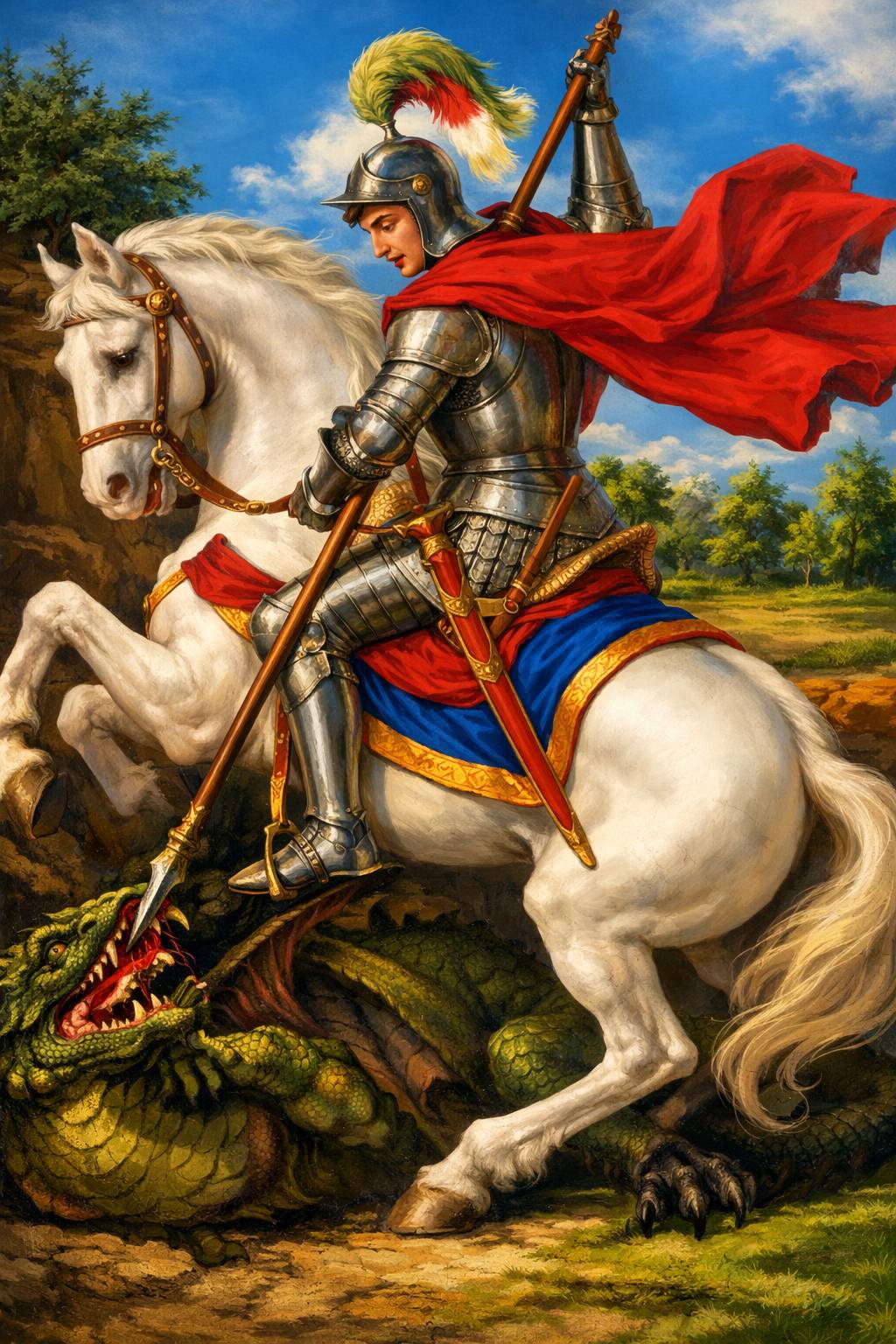
One of the greatest and most famous miracles of St. George occurred in the city of Silene in Libya. Near the city, a massive, venomous serpent (often depicted as a fire-breathing dragon) lived by a lake, polluting the entire area with toxic gas. The citizens tried to kill it with their army but failed. To appease the beast, they fed it two sheep daily. When the sheep ran out, they drew lots to sacrifice humans.
One day, the lot fell to the King's beautiful and devout daughter. Heartbroken but left with no choice, the King watched as his daughter, dressed as a bride, walked toward the beast, weeping and praying to Jesus Christ. As she approached her death, St. George happened to ride past. Seeing the grieving princess, he charged the beast on his horse. Invoking the name of Christ, he pierced the serpent with his spear, bringing it to the ground.
He instructed the princess to bind the serpent's neck with her sash, and she led the subdued beast into the city. The terrified citizens fled, but St. George proclaimed: "Do not fear! Believe in Jesus Christ, prepare for baptism, and I will slay this serpent completely." The King and his people rejoiced and agreed. Over 10,000 people were baptized that day. Though the King offered him immense wealth, St. George asked that it be distributed to the poor, leaving the King with four requests: Protect the Christian church, honor the priests, attend church regularly, and show compassion to the poor.
His Glorious Martyrdom
During Emperor Diocletian's persecution, when many abandoned their faith out of fear, St. George publicly tore down the Emperor's anti-Christian decree and boldly proclaimed his faith. A pagan leader named Dadianus arrested him, subjecting him to unimaginable tortures.
He was bound, beaten, and burned with hot irons, but by the power of Jesus Christ, he remained unharmed. He was given a deadly poison, but it had no effect, leading the poisoner to convert to Christianity and accept martyrdom. They tied him to chariots to tear him apart, but the wheels would not move. He was thrown into a cauldron of boiling metal, yet emerged without a burn.
Finally, Dadianus brought him to a pagan temple to force a sacrifice. St. George prayed loudly to the Lord, and fire descended from heaven, destroying the temple and the idols. Witnessing this, Queen Alexandra believed in Christ. Furious and unable to break his faith, Dadianus ordered St. George to be beheaded with a sword. The great saint received his martyr's crown, and Western and Eastern churches have joyously celebrated his feast on April 23rd since the 4th century.